

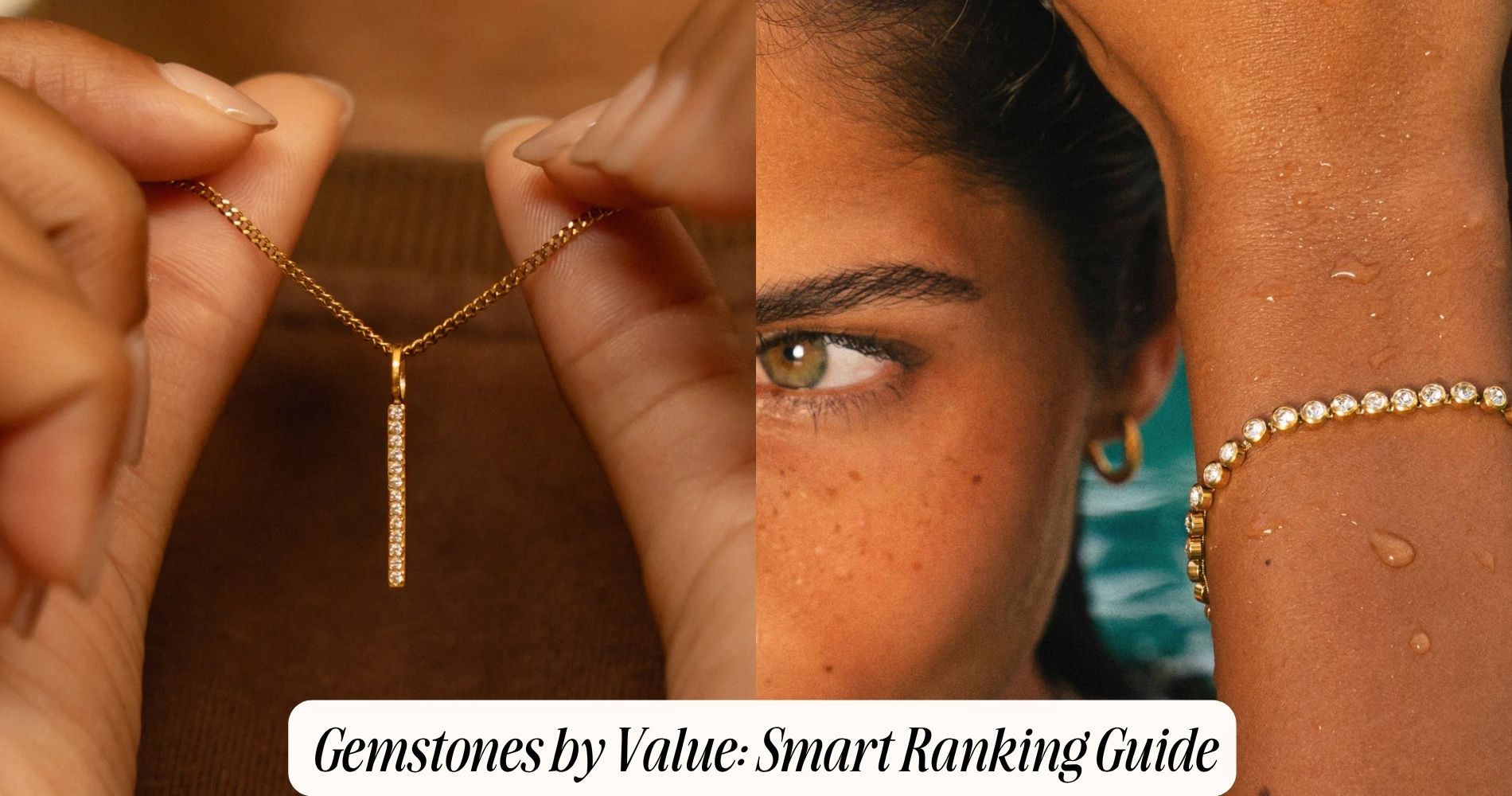
Gemstones by Value: Smart Ranking Guide
You rank gemstones by value best when you treat them like lab-grade assets: focus on color chemistry (hue, tone, saturation), clarity under 10×, precision cutting, and carat weight. Compare diamonds, Burmese ruby, Kashmir sapphire, Colombian emerald, and Imperial jadeite on a strict price-per-carat basis, then factor in origin reports and treatment history (heat, oil, diffusion). Prioritize untreated, top-color stones with elite provenance to understand how professionals structure a true value hierarchy—many examples of which appear across the Stone Collection.
How Gem Experts Judge Value
When gem experts judge value, they systematically analyze a stone’s “4Cs” and beyond—color, clarity, cut, carat weight—along with origin, treatment history, and overall crystal quality.
In a professional gemstone appraisal, you’ll also weigh geographic provenance, inclusion morphology, and spectroscopic indicators of enhancement. You apply valuation methods that integrate rarity factors, market trends, and a gem’s historical significance, then benchmark against recent auction results.
You’ll rely on recognized certification systems—such as GIA, AGL, or SSEF reports—to validate identity, treatments, and grading consistency.
You then reconcile lab data with current pricing fluctuations across wholesale and retail channels.
Finally, you compare your calculated value with published price guides and seasoned expert opinions to arrive at a defensible, transparent valuation.
Top-Tier Gemstones Ranked By Value
At the very top of the value hierarchy, a small cohort of gem species and varieties—primarily diamond, ruby, sapphire, emerald, and a handful of ultra-rare collector stones like alexandrite, Paraíba-type tourmaline, and jadeite—consistently achieve the highest price-per-carat benchmarks in the global market.
You’ll rank these top-tier stones by integrating supply scarcity, market liquidity, and documented auction records.
Diamond remains the benchmark for transparent pricing, but untreated Burmese ruby and Kashmir sapphire often surpass it in per-carat value due to extreme geological rarity and historical significance.
Fine Colombian emerald and Imperial jadeite occupy similarly elite strata.
Alexandrite and Paraíba-type tourmaline function as “connoisseur” rare gemstones, where minute improvements in saturation or phenomena yield exponential price jumps.

Color, Clarity, Cut, Carat And Value
Beyond species and origin, value concentrates around the classic “four Cs”—color, clarity, cut, and carat weight—which gemologists treat as interdependent variables rather than isolated checkboxes.
You assess color significance first: hue, tone, and saturation must align with each variety’s “ideal” to maximize value perception.
Next, you evaluate clarity impact by mapping inclusions, fractures, and growth features under 10× magnification, since visibility and position directly influence brilliance and durability.
You then examine cut styles—brilliant, step, or mixed—looking at proportion, symmetry, and polish to optimize light return rather than mere face-up spread.
Finally, you balance carat weight against these factors, knowing price doesn’t scale linearly; larger stones magnify any color, clarity, or cutting deficiency.
How Origin And Treatments Change Gem Prices
Although the “four Cs” define a stone’s internal merits, origin and treatment history frequently override them in the marketplace by acting as powerful price multipliers or discounts. You must evaluate origin impact first: Burmese ruby, Kashmir sapphire, or Colombian emerald routinely command steep premiums over geologically similar material from secondary localities.
Laboratories verify origin via inclusion microscopy, trace-element chemistry, and spectral fingerprints, so you can’t rely on dealer claims alone.
Next, quantify treatment effects. Untreated stones with verifiable reports sit at the top of the price curve. Standard heat in corundum usually causes moderate discounts, while glass-filled fractures, diffusion, or beryllium treatment trigger deep devaluations.
For emerald, clarity enhancement with minor cedar oil is acceptable; unstable polymer, resin, or dyed fillers sharply reduce marketability and price.

Investing In Gemstones: Holding, Liquidity, Risk
Once you understand how origin and treatment drive price multipliers, you can assess gemstones not just as collectibles but as illiquid, high-friction assets with specific holding risks.
You’ll need explicit risk assessment: map current and historic market trends against specific species, origins, and quality grades.
Your investment strategies should define target holding periods, expected volatility bands, and exit thresholds, since price fluctuations can be abrupt in thinly traded segments.
Liquidity options are constrained: you typically rely on auction houses, specialist dealers, or private-treaty sales, all shaped by shifting collector preferences.
Robust valuation methods—combining lab reports, comparables, and replacement-cost analytics—are essential to avoid mispricing.
Treat each stone as a long-duration, non-yielding position with significant transaction friction and asymmetric information.
Smart Buying Moves For High-Value Gemstones
Several disciplined buying habits separate opportunistic gemstone speculation from methodical, risk-aware acquisition of high‑value stones.
You start with strict gemological due diligence: insist on reputable lab reports (GIA, AGL, SSEF), verifying origin, treatments, and clarity enhancement disclosures. You correlate this data with price-per-carat benchmarks, calibrating bids to current market trends rather than dealer narratives.
You prioritize top-tier color, cut precision, and rarity over mere carat weight, aligning purchases with clearly defined investment strategies and exit horizons.
You avoid heated or heavily treated stones when collector-grade, untreated material is accessible. You cross-check auction records, dealer asking prices, and wholesale lists to detect mispricing.
Finally, you diversify across stones, vendors, and geographies, negotiating firmly and refusing pieces lacking transparent provenance.
Rising Undervalued Gemstones With Growth Potential
Market inefficiencies in colored stones often surface first in secondary or “connoisseur” species—gems that show elite optics and increasing scarcity but haven’t yet been fully repriced by mainstream demand.
You’ll see rising trends in stones like spinel, hauyne, mahenge garnet, and chrysoberyl (including alexandrite) as lab reports increasingly document unheated status, high saturation, and clean crystal.
You should track market predictions through auction comparables and per-carat price progression in certified stones.
Focus on traceable origin, consistent RI/SG data, and stable chromophore chemistry under spectroscopy.
Prioritize untreated, well-cut material with strong fluorescence or color-change phenomena, since these features often trigger the steepest repricing once supply tightens and dealer awareness catches up.

Frequently Asked Questions
How Do Gemstone Values Compare to Gold, Stocks, or Cryptocurrency Over Decades?
You’ll see gemstones show slower, steadier appreciation than gold, stocks, or crypto. When you model gemstone appreciation trends, you’ll typically observe lower market volatility comparison, but higher liquidity constraints, grading sensitivity, and provenance-driven price dispersion over decades.
What Certifications and Labs Best Protect Buyers From Overpaying for High-Value Gems?
You rely on certification importance from trusted labs like GIA, AGS, SSEF, and Gübelin; they provide rigorous grading, spectroscopy, origin analysis, and treatment disclosure, minimizing price inflation and helping you benchmark fair market value precisely.
How Can I Safely Insure an Expensive Gemstone or Gemstone Collection?
You insure gems safely by commissioning a qualified lab-based appraisal process, documenting grading reports and high-res photos, then comparing scheduled jewelry insurance options, confirming agreed-value coverage, worldwide protection, vault-storage riders, sub-limit terms, and strict proof-of-loss requirements.
What Are Common Gemstone Scams and Red Flags in Online Marketplaces?
You’ll encounter misrepresented treatments, synthetic stones sold as natural, and fake certifications. Scrutinize spectroscopic data, grading reports, seller provenance, return policies, and online reviews, and verify report numbers directly with recognized gemological laboratories.
How Often Should High-Value Gemstones Be Reappraised for Accurate Current Market Value?
You should schedule appraisal frequency every 2–3 years; tighten to annually during rapid market fluctuations. Follow expert recommendations, especially for rare stones, to detect value depreciation, verify grading consistency, and recalibrate insurance coverage to current gemological and auction comparables.
Conclusion
You’re now equipped to evaluate gemstone value with a lab-grade mindset. When you examine color saturation, clarity characteristics, precision cutting, and carat distribution, you’re not guessing—you’re quantifying. By factoring in geographic origin, treatment status, market liquidity, and long-term risk, you can treat each stone like a data-backed asset. Use grading reports, spectroscopic data, and price-per-carat benchmarks so every purchase behaves like a controlled, replicable experiment in value.






,%20clarity%20under%2010%C3%97,%20precision%20cutting,%20and%20carat%20weight.%20Compare%20diamond...)
Leave a comment
This site is protected by hCaptcha and the hCaptcha Privacy Policy and Terms of Service apply.