

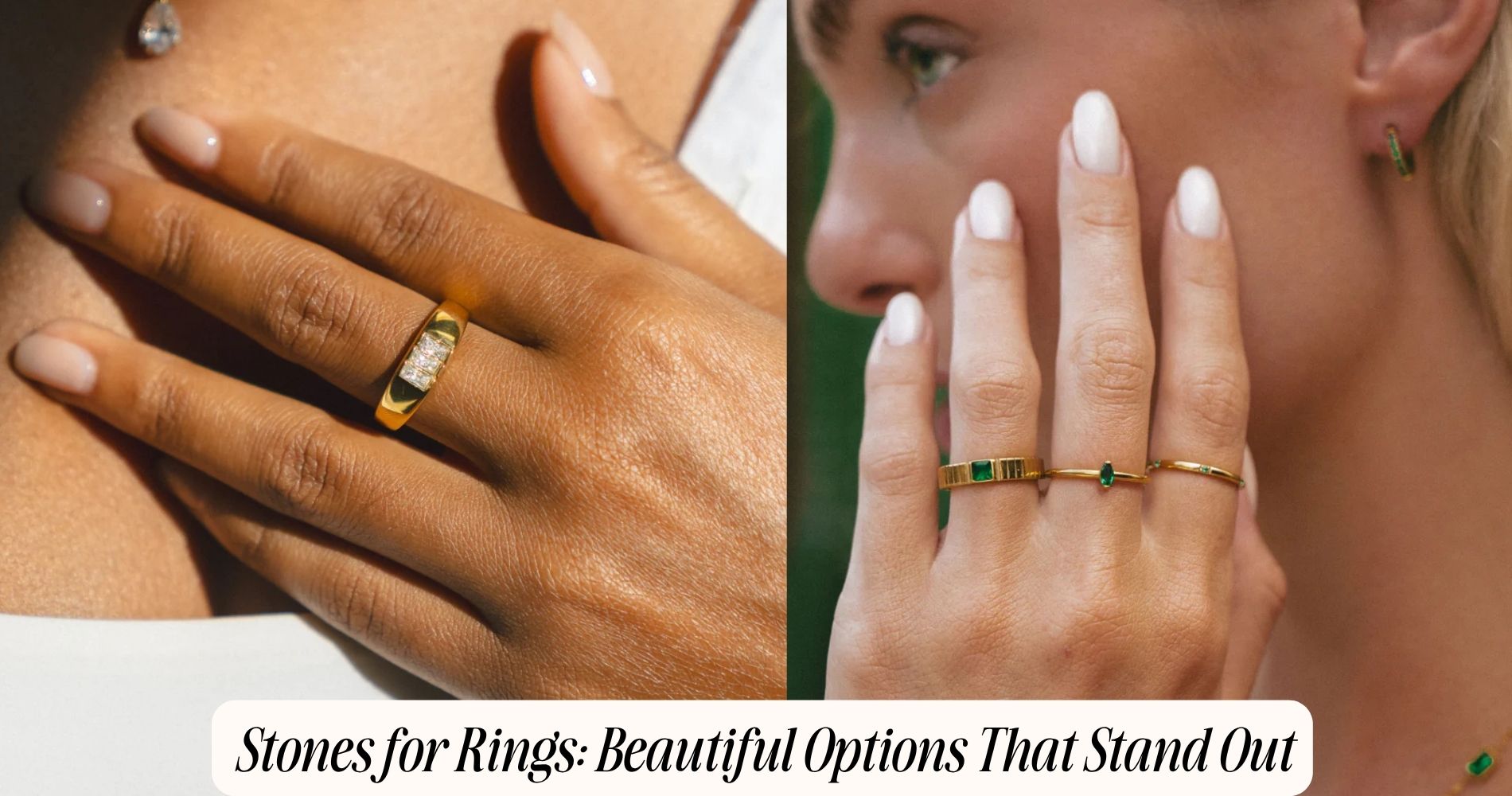
Stones for Rings: Beautiful Options That Stand Out
When you choose stones for rings, you’re really choosing crystal chemistry and optics: diamond and moissanite deliver top hardness, high refractive index and crisp or rainbow fire, while corundum (ruby, sapphire), spinel, and garnet offer saturated color with strong brilliance and toughness for daily wear. More unusual options like sphene, alexandrite, tourmaline, and feldspar gems add rare dispersion, color-change, or iridescence, plus vintage cuts and settings that dramatically alter performance and personality—many of which can be explored in the Stone Collection.
How to Choose the Right Ring Stone
Why does one stone feel intuitively “right” for a ring while another seems unsuitable the moment you try it on? You’re responding to a matrix of optics, crystallography, and proportion.
First, evaluate hardness (Mohs ≥ 7.5) and toughness so the gem resists abrasion and cleavage during daily wear.
Then assess stone colors: hue, tone, and saturation must complement your skin’s undertone while remaining stable under varied lighting.
Examine refractive index and dispersion, which govern brilliance and fire, especially in small ring-scale gems.
Next, scrutinize stone shapes—oval, cushion, emerald, pear—since facet architecture controls scintillation patterns and perceived size.
Finally, consider pleochroism, birefringence, and inclusions; these internal features can enhance character or compromise durability and visual performance.

Diamond and Moissanite: Classic Clear Options
Although both read as “colorless” at first glance, diamond and moissanite differ fundamentally in chemistry, crystal structure, and optical behavior, giving you two distinct pathways to a clear, high-performance ring stone.
Diamond is crystalline carbon, cubic, with perfect octahedral cleavage, adamantine luster, and extreme hardness (Mohs 10). Moissanite is silicon carbide, typically 4H/6H polytypes, with no true cleavage, high toughness, and comparable hardness (~9.25).
When you make diamond comparisons, you’ll notice diamond’s lower dispersion (≈0.044) yields crisp, controlled fire, while moissanite’s higher dispersion (≈0.104) creates more spectral “rainbow” flashes.
Refractive index differs too: diamond ~2.42, singly refractive; moissanite 2.65–2.69, doubly refractive, giving noticeable facet doubling.
Key moissanite advantages include price efficiency, outstanding durability, and strong optical performance.
Colorful Gemstones That Really Pop
Once you move beyond colorless brilliance, saturated gemstones introduce chromophore-driven optics that can make a ring visually dominate the hand.
You tap into vibrant hues created by trace elements substituting into crystal lattices: chromium and vanadium in corundum yield ruby and certain sapphires; iron-titanium intervals generate classic blue sapphire.
You can choose emerald, a beryl colored by chromium or vanadium, for rich green pleochroism and strong internal jardin that enhances individuality.
Spinel, often chromium- or iron-bearing, offers neon-like reds and hot-pink tones with high refractive index for sharp scintillation.
Tourmaline provides a full spectrum—from indicolite blues to rubellite pinks—often with zoning that produces striking contrasts.
Garnet group species, like pyrope-almandine mixes, deliver saturated reds with exceptional dispersion.
Most Durable Stones for Everyday Wear
Vivid chromophore-rich gems may command attention, but a ring you wear daily has to withstand constant abrasion, impact, and chemical exposure, which puts a premium on specific physical and mechanical properties.
You should prioritize minerals with high Mohs hardness, superior fracture resistance, and stable crystallographic structures.
Diamond, at Mohs 10 with adamantine lustre and exceptional wear resistance, remains the benchmark.
Corundum—ruby and sapphire—follows closely; outstanding sapphire durability arises from its 9 hardness, lack of cleavage, and dense hexagonal lattice.
Spinel and chrysoberyl also offer excellent hardness and toughness, resisting facet wear and chipping.
You must treat emerald toughness differently: its beryl structure, combined with common fissures, reduces resistance to impact, making it less ideal for intensive, everyday ring wear without protective settings.
Budget-Friendly Stones for Every Budget
Even when you’re working within strict cost limits, you can select ring stones with sound crystallography, stable color centers, and respectable wear resistance if you understand where value comes from in the gem market.
You’ll find affordable alternatives by prioritizing abundance, synthesis, and optimized cutting.
Choose lab-grown corundum (ruby and sapphire) for high refractive index, solid 9 Mohs hardness, and predictable saturation.
Spinel, both natural and synthetic, offers sharp dispersion and excellent toughness at moderate prices.
Quartz varieties—amethyst, citrine, smoky quartz—provide macrocrystalline clarity and good cleavage resistance when bezel-set.
For ultra-budget, cubic zirconia and lab-grown moissanite deliver high brilliance and fire, making them trendy selections that visually rival pricier gems while remaining cost-efficient and replaceable.

Meaningful Stones: Birthstones and Symbolism
Cost isn’t the only variable that guides stone selection; you may also anchor your ring design in birthstones and their associated symbolism.
When you explore birthstone meanings, you align optical properties and chemistry with personal narrative. January’s garnet (a nesosilicate group) symbolizes protection; its high refractive index yields saturated, fiery reds.
February’s amethyst, a macrocrystalline quartz, conveys clarity and spiritual balance through its Fe-induced violet hue.
You might choose diamond or white sapphire as April birthstones, linking extreme hardness with resilience.
Emerald, a Cr- or V-bearing beryl, represents renewal, while September’s corundum sapphire embodies loyalty and mental focus.
Unique Stones That Truly Stand Out
While mainstream center stones dominate most showcases, you can specify less conventional minerals whose crystal chemistry and optical behavior immediately distinguish your ring.
Consider sphene (titanite), whose ultra-high dispersion exceeds diamond, yielding prismatic fire in precision-cut stone shapes. Spinel, a magnesium aluminum oxide, offers exceptional single-refraction brilliance and superior toughness for daily wear.
You might choose color-change alexandrite, exploiting chrysoberyl’s complex absorption spectra for dramatic shifts under different light sources.
For moody iridescence, labradorite and moonstone display feldspar’s lamellar twinning and schiller.
To protect softer species like opal or turquoise, use bezel or halo alternative settings that shield exposed girdles and edges.
Calibrated cuts, fantasy faceting, and freeform silhouettes further emphasize each mineral’s unique optical performance.
Vintage-Inspired Stones With Old-World Charm
Although contemporary cuts and lab-grown options dominate many showcases, vintage-inspired stones evoke historic lapidary practices, antique faceting styles, and bygone color palettes that lend a ring tangible old-world character.
You’ll often gravitate toward vintage cuts such as old mine, old European, and rose cuts, which emphasize higher crown angles, smaller tables, and broad, chunky scintillation rather than hyper-brilliance.
You might choose slightly included, warm-toned diamonds in K–M color grades, or opt for corundum (sapphire, ruby) with velvety, silk-rich interiors that soften luster.
Old-world charm also comes from step-cut spinel, cushion-cut garnet, or foil-backed paste replicas in historically accurate palettes.
When you pair these stones with period-correct antique settings, their dispersion, bodycolor, and extinction patterns read unmistakably heirloom.
How Ring Settings Change Your Stone’s Look
Mounting geometry transforms how a gem behaves in light, so the ring setting becomes an optical instrument as much as a decorative frame. When you choose stone settings, you’re controlling light entry, reflection, and dispersion.
A high, open prong setting maximizes brilliance in high-refractive stones like diamond or moissanite, while a bezel compresses the profile, emphasizing outline and color zoning instead of scintillation.
Gallery height and metal reflectors alter visual impact, either brightening a shallow pavilion or deepening saturation in colored gems such as sapphire or tourmaline.
Halo and cluster architectures increase apparent carat spread and modify how your eye reads symmetry. Through these style variations, you exert decisive design influence over fire, scintillation, and perceived color intensity.

Care and Maintenance for Popular Ring Stones
Because each gem species interacts differently with heat, chemicals, and mechanical stress, effective ring care depends on understanding your stone’s specific crystal chemistry and physical properties.
You’ll clean diamond, corundum (sapphire, ruby), and beryl (emerald, aquamarine) differently from porous or cleavable gems like opal, pearl, tanzanite, or topaz.
For stone cleaning, use mild detergent, lukewarm water, and a soft brush on durable gems (MOHS 8–10), avoiding ultrasonic or steam for fracture‐filled, oil‐treated, or heavily included stones.
Keep opal and pearl away from detergents, acids, and ammonia; just use a damp cloth.
Apply careful storage tips: segregate rings in individual, fabric‑lined compartments so harder species don’t abrade softer ones, and control humidity for opals and organic gems.
Frequently Asked Questions
Can I Ethically Source Colored Gemstones and Trace Their Origin?
Yes, you can if you verify mine-to-market sourcing methods, demand ethical certifications (Fairmined, Fairtrade, RJC CoC), and request batch-specific documentation detailing deposit locality, extraction practices, cutting centers, and supply-chain custody for each individual corundum, beryl, garnet, or spinel.
What Ring Stones Are Best for Sensitive or Allergy-Prone Skin?
You’ll tolerate inert natural stones like diamond, sapphire, ruby, spinel, and chrysoberyl best, set in hypoallergenic metals such as platinum, palladium, or high‑karat gold; avoid nickel alloys and plated settings to minimize cutaneous sensitization.
How Do Stone Choices Differ for Engagement Versus Fashion Rings?
You prioritize durable, high-Mohs, optically pure stones with classic engagement symbolism (diamond, sapphire) for engagement rings, but choose broader gem species, treatment types, and color varieties in lower-wear settings for maximum fashion versatility and experimental aesthetics.
Are There Stone Options That Photograph Especially Well for Social Media?
Yes, you’ll find photogenic gemstones like well-cut diamonds, spinel, and sapphire excel, as their high refractive indices and dispersion intensify vibrant hues, sharp facet reflections, and contrast under LED lighting, enhancing clarity, brilliance, and scintillation on-camera.
Can I Mix Multiple Stone Types in One Ring Without Design Issues?
You can, but you must balance stone durability considerations and design harmony principles. Match Mohs hardness, cleavage, and toughness, coordinate refractive indices, dispersion, and pleochroism, and use protective settings for softer accent gems adjoining harder, abrasive center stones.
Conclusion
Now that you know your options—from adamantine-luster diamond and high-dispersion moissanite to richly saturated corundum, beryl, and garnet—you can match a stone’s refractive index, Mohs hardness, and cleavage profile to your lifestyle. Weigh durability, optical performance, and budget against aesthetics and setting style. When you prioritize proper mounting, routine cleaning, and professional inspections, your chosen gemstone won’t just look brilliant—it’ll remain structurally sound and visually striking for years.





Leave a comment
This site is protected by hCaptcha and the hCaptcha Privacy Policy and Terms of Service apply.